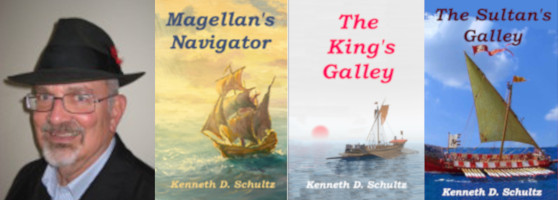
Editing is a necessary thing, but not something I enjoy. Just got through Magellan’s Navigator. It is now in pretty good shape. One more time through, and then it’s off to beta readers.
Editing is a necessary thing, but not something I enjoy. Just got through Magellan’s Navigator. It is now in pretty good shape. One more time through, and then it’s off to beta readers.
Filed under Art and Craft of Writing, Magellan's Navigator
I recently finished Brandon Sanderson’s The Way of Kings and Words of Radiance, the first two books in his planned Stormlight Archive series. Both are thousand plus page books.
The books are an excellent, multi-faceted fantasy with engaging characters and an imaginative world. This isn’t a retread of orcs and elves, but an entirely original world. Most the story revolves around an enslaved warrior, a middle-aged battle-weary prince, and an ambitious young female scholar. In the first book, magic doesn’t seem common in the world, although mysteries abound in the world. In a masterful way, Sanderson slowly reveals the world’s truths to the characters and the reader, although beware, everything revealed may not be indeed be the truth. He does a great job. I found myself identifying with all three major protagonists.
Things I liked are the story’s originality, empathetic characters, and the twists and turns of character reveals. This story is huge and multi-layered. I haven’t figured out how everything fits together, but I will trust the author that it does. I like the way most, if not all, the baddies aren’t out and out evil like the Dark Lord of Mordor. The villains are generally doing what they think is right, although that may not be apparent at the first.
Things that could be improved: there was surprising number typos in the first book. Some people complain about typos in self-published works. Well this book is the product of a major publisher. The second book has far less typos. These books are not page-turners. Sanderson slowly develops things, and as a reader, I relaxed and enjoyed that. That said, enough is enough at times, and one or two hundred pages could be sliced out each book without hurting the story (you can skim without hurting the reading experience.) Occasional scenes don’t seem to ring true, but hey, there are many scenes and another person might have a different opinion.
One takeaway for me as a writer is that I especially liked Sanderson’s slow reveal of his world and characters’ backstories. I’ve always regretted revealing the circumstances of Adam’s sister’s death as early as I did in Download. Originally, it was much later in the novel, but I moved it up after a beta reader said he wanted to know it NOW. Well, maybe he did want to know it now, but that didn’t mean I should have given it to him now.
On the other hand, I did find annoying Sanderson using entire chapters of “five years earlier.” I cringed when I saw that in a chapter heading, and prefer having the backstory weaved into the here and now story.
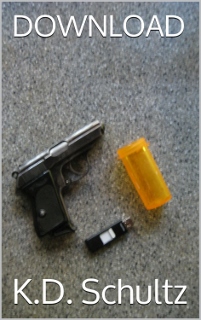
My thriller Download is available for FREE (as an e-book) this weekend only on Amazon. Read it, enjoy it, and please review it.
Filed under Download
I just returned from a “traveling light” vacation with my wife, which meant no laptop. No laptop meant no writing, which was a good thing. It forced me into some serious thinking about “my next science fiction novel.”
One decision made was a working title, as “my next science fiction novel” is a bit wordy. I’ve decided on Mindfield. Many thanks to our friend Pam for suggesting it. (Pam is the daughter of Krin, the namesake of the empathetic co-protagonist of my Truth-Teller books.)
I’m excited about Mindfield’s concept and storyline. If the written product is anything like what’s in my head right now, I should have a winner.
I want to write this novel more efficiently. Some authors might sneer at that concept. I’ll agree a purely character driven novel probably can’t be written efficiently. On the other hand, I believe most successful authors of plot driven book thrillers do a detailed outline. Most novels lie somewhere in between these two extremes. Mindfield will have a strong protagonist, who’ll experience serious change during the course of the book, but it will also have a twisty-turny plot.
I’ve always done a rough outline, followed by a first draft. That was fun, but then things got messy. I’d add or delete characters. I’d change plot points. These resulted in tedious rewrites that took time and weren’t fun. All those changes made it easy for me to miss the renaming of a city or a character. That meant more typos to catch, and I hate typos.
I believe that having a more detailed outline should produce a better result with less angst and effort. That outline includes decisions on point of view, characters, protagonist and antagonist, and story arc. I’ll be sharing these over the next few weeks.
Filed under Art and Craft of Writing
Just because I’m still rewriting Magellan’s Navigator doesn’t mean I’m not planning my next Sci-fi work.
First there comes the concept, the germ, the seed of an idea. Many book ideas surface in my head, but an idea takes a second and writing a book takes months. So I must thin these seedling ideas, so the best can grow.
It all starts with what if?
What if the protagonist thinks they’re human, but they’re really an A.I., or maybe they are human, or something else entirely, like an alien. My reader will take this journey of self-discovery with my protagonist set against a little space opera and a little romance.
Think Blade Runner meshed with Old Man’s War.
Future blogs will discuss my own journey in first designing and plotting this book, and then writing it. There are many things to decide. Whose and how many points of views should I use? What events propel the plot? What is the “world” in which the story takes place?
Filed under Art and Craft of Writing
My wife and I saw The Imitation Game yesterday. It’s a fantastic movie. Benedict Cumberbatch’s performance deserves an Oscar. Cumberbatch portrays the great mathematician Alan Turing, who has a cameo role in my thriller Download. The movie is about Turing’s tortured personality, but it is centered about the breaking of the unbreakable Nazi Enigma code in World War II. I’ve been interested in codebreaking since my Navy time at the Naval Security Group, and codebreaking and electronic intercepts are a key component of Download.
The Imitation Game revolves around real historical people and real historical events. By all accounts the movie does not deal faithfully with either. Turing played a critical role in the breaking of the Nazi Enigma code, but he was one person of a huge effort involving thousands of people, not the six analysts in the film. Turing’s film personality is also likely not accurate.
These inaccuracies are good. A painstakingly faithful history of the codebreaking effort would be boring. The Imitation Game captures the essence of this effort, the social restrictions of England seventy-five years ago, and the moral dilemmas faced by Turing, Winston Churchill, and all in the intelligence community when they finally held the uncoded Enigma messages. Do they use the information now and save lives, but risk compromising their codebreaking efforts, or do they use the information more judiciously and strategically?
In less than two hours the makers of The Imitation Game successfuly capture the essence of these times and people better than a history book. I encourage you to see the movie if you haven’t already.
Truth-Teller Revenge by Kenneth D. Schultz, the sequel to Truth-Teller Rebellion is available today at e-book sellers.
Wormhole technology is a reality and promises to be the salvation of mankind. That is, if the battle over its control doesn’t destroy civilization first.
Cary sees a chance to end the war while getting revenge on the man responsible for killing his father and his lover. There’s one problem. It’s a suicide mission. When Krin discovers this, she’s determined to use all her emotion-twisting powers to keep him alive.
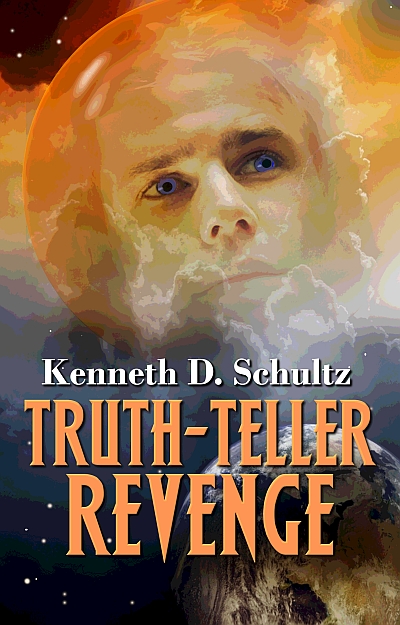
Truth-Teller Revenge is available at:
Amazon http://goo.gl/vDJBrK
Barnes & Noble http://goo.gl/8OMhRq
Champagne Book Group http://goo.gl/UeVaZn
Filed under Truth-Teller Books
While life may be a journey, writing has been a plodding trek for me of often three steps forward and then four steps back. I researched my first novel, a historical novel about Magellan’s circumnavigation of the world, for a year. Then I took a year writing the first draft of my novel, after which I attended the Pacific Northwest Writers Association summer conference to pitch it. There I sat in on a session on Point of View. POV? I’d never heard of point of view, but after the session I knew I had way too many of them.
My Magellan novel might have worked fifty years ago, when an omniscient POV was acceptable, but modern writing techniques are different from those of my youth. So I rewrote my novel, drastically reducing the POV’s in the process. Tim Joyner, the author of Magellan, which I consider the definitive book on Magellan, graciously agreed to read my novel. He said it was good as history, but since it was historical fiction, why didn’t I use that latitude to make my novel more engaging. He was right. I set my Magellan novel aside and moved on.
I wrote 2 and 20 in 2008. It was a fun novel to write. The protagonist’s marriage explodes, he compromises his principles to keep his job, but his job explodes anyway, he finds love, he almost loses love, but in the end, he regains his love and an honorable job. Problem? I didn’t think about what genre I was writing, which made it almost impossible to market to an agent. Maybe I’ll self-publish it someday.
They say to write what you know. I know finance. In 2008, I wrote Download, a techno financial thriller. It has a little of the attitude of Nelson DeMille, while giving the reader a peek into the world of mathematics and the odd cast of characters responsible for the theories that have made computers, cell phones, and most of modern life possible. A few agents showed interest, but none bit.
They say to write what you love to read. I love to read science fiction. 2010 gave birth to Truth-Teller Rebellion and 2011 to Truth-Teller Revenge, which Champagne Books published in 2014 and 2015.
Once Truth-Teller Revenge was off to my publisher this past summer, I circled back and rewrote and re-edited Download. Then, as an experiment, I self-pubbed it on Amazon this last November.
I wrote five books in five years from 2007 to 2011, and have since published three of the five. However, I haven’t written anything in the past three years. Sad. Sad, but not because I’ve been lazy. I’ve spent the last three years editing, rewriting, and editing, and then getting a blog and Facebook set up, etc. etc. All of this was necessary, but not nearly as fun as writing.
What lessons have I learned while I’ve been on this trek?
* Learn your craft. Read about writing, read modern novels, and then perfect your craft by writing.
* Craft is not enough. Your plot or your characters must be so engaging that the reader can’t put your book down. This is what I find most difficult. As a writer, I become so close to my characters that I find it difficult to imagine what the first time reader will think of them. Writing in the first person helps, I think, and I’m gravitating to that POV.
* Know what genre you’re writing. Yes, you can push the limits of a genre, but ignore the expectations of a genre at your own risk.
* Write, write, write. Even if you only average 250 words per day, that means a full size 80,000 plus word novel at year end.
* Editing is not fun. At least for me. Write books that require minimal editing before publishing.
Resolutions for 2015
* Write. Get back to writing.
First project. Rewrite the Magellan novel as a “memoir.” I started this a month ago, and it’s going well. It’s going faster than I expected because I’m recycling major portions of the original novel.
Second project, a new sci book?
* Write cleaner books the first time, which will then require less editing. I’ve learned a lot about writing from working with my Champagne editors. Combining that knowledge with a little more focus should result in books that require less editing. Less editing means more time for the fun stuff: creating stories, universes, and characters.
Here’s to the future and all the books in it.
Filed under Art and Craft of Writing, Download, Truth-Teller Books
Please click on the book cover to check it out.
Filed under Download

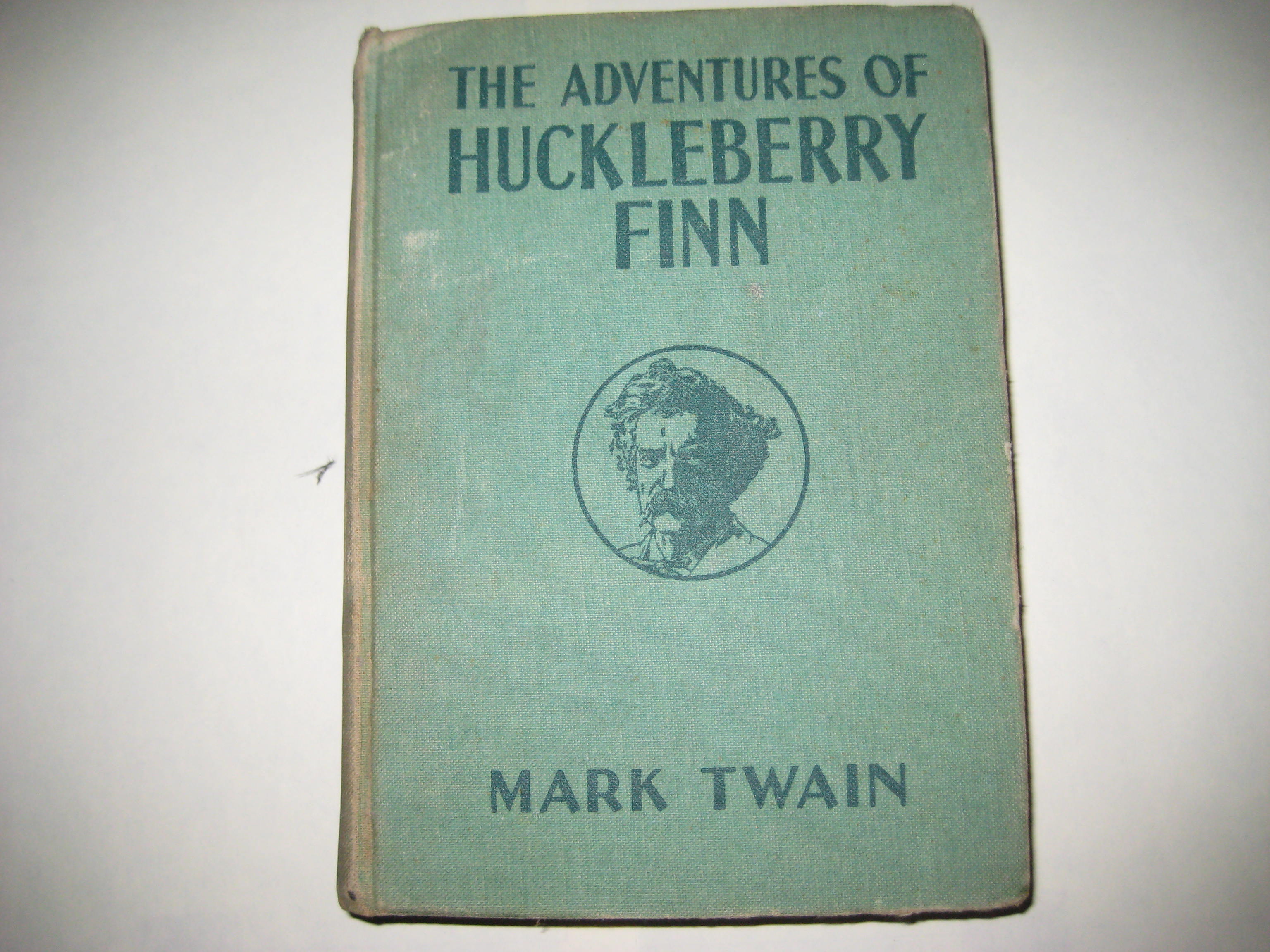
Check out the NOTICE in this copy of Huck Finn. I was more than a little concerned about being prosecuted, banished, or shot after reading this in the seventh grade. What made this even more alarming was that I didn’t know what a plot was at the time and maybe not even what a moral was. My copy is from around 1918 and was old even when I first read it. I have no idea how I came to own it.
Filed under Art and Craft of Writing
 | kennethdschultz on September 26, 1519 – Magellan’… |
| kennethdschultz on My Favorite Aliens |
 | Sidney Fritz on My Favorite Aliens |
 | Evan Siroky on September 26, 1519 – Magellan’… |
| Dave Mueller on Marbella and the Costa del… |


 kennethdschultz