Truth-Teller Revenge is available for Pre-order.

Truth-Teller Revenge is available for pre-order.

Wormhole technology is a reality and promises to be the salvation of mankind. That is, if the battle over its control doesn’t destroy civilization first.

Cary sees a chance to end the war while getting revenge on the man responsible for killing his father and his lover. There’s one problem. It’s a suicide mission. When Krin discovers this, she’s determined to use all her emotion-twisting powers to keep him alive.

Truth-Teller Revenge is available for pre-order for delivery as an e-book on January 5, 2015 at most e-book vendors including Amazon.

Leave a comment

Filed under Truth-Teller Books

My thriller DOWNLOAD is published

My book Download is now available on Amazon published under the name K.D. Schultz. It’s a thriller set against the financial meltdown of 2008. A geeky National Security Agency analyst uncovers a band of murderous computer hackers and finds himself next on their hit list.

1 Comment

Filed under Download

Editing Isn’t Fun, But It’s Necessary

I just reviewed the final galley of Truth-Teller Revenge. It looked great with only two small changes. Hurrah. Revenge is still on track for a January release.

Every author should strive to put out an excellent product. That requires an excellent plot and interesting characters. That’s the fun part. A quality book also requires meticulous editing, but poring over a manuscript line by line isn’t fun. I’ve gone half cross-eyed editing since June.

I’ve made a resolution to write cleaner, more typo free books. I’ve seen others in my critique group do it. I’m thinking of you, Laura Henson. One aid I recently learned of is the editing ‘option’ menu under ‘file’ in Word 2010. That will help eliminate some errors.

Unfortunately, some things don’t come easy to me. Word order is a bit of a problem. I blame it all on my dear mother. Inverted word order was natural to her, and sounds natural to me. She in turn blamed it on the Amish neighbors of the family farm in Painesville, Ohio. It just means I have to work a little harder.

Leave a comment

Filed under Art and Craft of Writing, Truth-Teller Books

Anathem: A Sci Fi Novel With An Exceptional Amount Of Science

Anathem by Neal Stephenson is a difficult book to review and at times to read. It’s a thousand page book. There’s a lot to love in it, but other parts fell flat for me. Here’s my take on it without any major SPOILERS.

The protagonist Erasmus, an avout, lives a monk-like existence in a scientific monastery on a world that is Earth-like, but it isn’t Earth. There is minimal contact between the avout in their monasteries and the secular world. What made it a slog is that the reader must negotiate a plethora of strange English-sounding words. Most these words have a meaning similar to something in English, but it takes a while to figure out just what. Nonetheless, the book intrigued me enough that I kept reading.

Stephenson likes his science. Anathem has more pages devoted to science and mathematics than any sci fi book I’ve read. For me, the many problems in logic and scientific descriptions weren’t necessary for the story and often slowed it down. I’m scientifically oriented, but I found myself skimming over portions.

The narrative picks up in the middle of the book. An alien ship is orbiting the planet. The avout and the seculars join together to deal with this possible threat. As a result, Erasmus finds himself on a quest through the secular world, which he is largely ill equipped to deal with. This middle part of the novel was my favorite.

The last third, which could have been a page-turner, became another slog. The alien ship is evidently from one or more parallel worlds or existences. Page upon page was devoted to discussing this. Enough! Someone studying the many-worlds interpretation of quantum mechanical may find this fascinating. I found it tedious and skimmed over large sections. For me Anathem has too much science. I need character, plot, and a gripping narrative.

Ironically, despite Anathem’s strong rooting in science, I found several unrealistic aspects of the novel, which pulled me from my suspension of disbelief. Most of these revolved around the unrealistic roles of Erasmus and his young colleagues in the last third of the book.

Young Cary, Krin, and Oliver in my Truth-Teller books have an impact on the world around them, but they do it in a credible way. Twenty-one year old Luther in Truth-Teller Revenge does assume leadership of the Jacombers, but he does it in his small, religiously charged community.

For being a logically oriented novel, Anathem has other disconnects. I don’t want to give out SPOILERS, but, among other issues, I don’t think the method of signaling the alien ship would have worked.

Anathem seems written for the YA scientific geek. I’m glad I read it, but I think less science and a more realistic plot would have made it a better novel.

Leave a comment

Filed under Art and Craft of Writing, Book and Movie Reviews

Seattle Authors Talk about Amazon and the Challenges of Getting Published

Check out this Seattle Weekly article about Amazon.

http://www.seattleweekly.com/home/955189-129/the-perks-pitfalls-and-paradoxes-of

It includes interviews with Seattle area authors Robert Dugoni, Megan Chance, and Greg Bear about the challenges of getting published. All three are very hard working and determined authors. I’ve heard Robert and Megan speak many times at the Pacific Northwest Writers Association Summer Conference. Greg Bear was the keynote speaker at the same conference a few years ago.

A few takeaways and thoughts:

* Wow, the book industry has totally changed in the seven years since the Kindle came out in 2007. It will change even more in the years ahead, but not in a predictable way. As Greg Bear points out, what is publishable in the e-book format is different from what was possible in the traditional world.

* Amazon’s transformation of the book business has been pretty hit and miss, and has been marked by several failures along the way.

* Amazon Publishing may be shunned by bookstores, but it has a huge advantage in e-books where Amazon is putting its marketing focus behind its own authors. This is making it more difficult on self-published authors and indie presses, like my publisher, Champagne.

* Even if you get a traditional book contract, it’s hard to get the next one.

* E-books have created more opportunities for writers than the traditional publishing business, but it still isn’t easy to establish a readership.

I don’t normally read the Seattle Weekly. I found out about this article from my daily e-mail from PW Daily, which is a free Publishers Weekly e-newsletter. I recommend all serious writers to subscribe to this newsletter so they can better understand the publishing business.

Leave a comment

Filed under Art and Craft of Writing

How Much Science Should a Sci Fi Book Have?

The typical sci fi book should have enough science in it to tell the story, and nothing more.

Conflict, and how the protagonist deals with that conflict, drives most good stories. Science interprets the reality of the world around us. By itself, science has no conflict.

Science is a secondary character in most novels. Devoting pages at a time to a secondary character is usually a mistake. I learned this from experience. When I first submitted Truth-Teller Rebellion to Champagne Press, it came back with a rejection, but with the comment that if, among other things, I wanted to eliminate the excess description (science in most cases) I could resubmit it. Thank you Champagne Press for that second chance. An example given was the two pages I had devoted to a detailed explanation of the construction and operation of a solplane. The editor was right. My two pages on solplanes just slowed down a story that already was a little too slow.

Often, a scientific idea is the spark behind a novel. For example, what if artificial intelligences no longer need mankind? That is the basis of The Fall of Hyperion and 2001: A Space Odyssey. However, what keeps the reader turning the pages in these classics is how the protagonist deals with this obstacle, not the science of artificial intelligences.

I recently read Anathem by Neal Stephenson. I admire this book for its originality, but the science of this book slowed it down. Anathem’s thesis centers on the many-worlds interpretation of quantum mechanics, MWIQM, which is roughly akin to the parallel worlds that inhabit many sci fi novels. I read the first discussions of MWIQM with care. However, there were more talking head discussions about MWIQM for pages at a time. I skipped over them all. Some quantum mechanics geeks might like these interruptions to the story, but they are a fine slice of the reading public. I suspect most readers will react as I did.

Putting science in a novel in most cases means more description. I like to get poetic with my descriptions. It pleased me that longandshortreview.com said in its review of Truth-Teller Rebellion that “Mr. Schultz’s scenery descriptions are not to be missed.” I was flattered, but that doesn’t mean I should write more and longer descriptions. When I’m writing my best, my descriptions mesh seamlessly with the dialogue and action.

Science is important to science fiction, but unless you want only hardcore science geeks for readers, keep the science short and sweet.

Leave a comment

Filed under Art and Craft of Writing, Truth-Teller Books

It’s Been a Hectic Month of Editing and Toddler Sitting. Which Makes Me Wonder: How Parents Find Time to Write and Raise Kids

I received the Truth-Teller Revenge galleys from my publisher for the final proof a little over a month ago. I went through them, and then my meticulous and wonderful wife caught everything that I hadn’t. There was a lot to catch and only ten days to do it in. I can’t believe I read “grim” for “grime” multiple times. It goes to show how difficult it is to edit one’s own book. After a discussion with my publisher, Truth-Teller Revenge will come out in January 2015, instead of this November. At the cost of a two-month delay in publishing, it will be a much better book.

Closely following the final edit of Revenge was the birth of our second grandchild, a lovely little girl who needed a little extra time at the hospital before coming home. While Mommy and Daddy were beside her at the hospital, my wife and I cared for our two-year-old toddler grandson for ten days. This experience gave me a greater appreciation for the time, energy, and attention it takes to raise children. Now that our granddaughter is at home getting settled with her family, I will be getting back to writing and blogging.

My hat is off to all you parent/writers. I don’t know how you do it!

Leave a comment

Filed under Art and Craft of Writing, Truth-Teller Books

Fuzzy Nation, a fun fast read, versus Hyperion, a monumental mindbender

John Scalzi’s Fuzzy Nation and Dan Simmons’ Hyperion/The Fall of Hyperion are both in their own way great books, but they couldn’t be more different.

Three hundred page Fuzzy Nation is a fast paced tale about Bruce Holloway, an ethically challenged prospector on a planet that may or may not be home to one of the few sentient beings encountered by mankind. Holloway is a disbarred lawyer who called his girlfriend a liar in court to save his own ass. A disbarred lawyer? Lied about his now former girlfriend? Did I say Holloway is ethically challenged?

Holloway is wrangling with Zaracorp over the ownership of a sunstone discovery. If he wins, he’ll be richer than Bill Gates. Then he meets his first Fuzzy. Per law if the Fuzzies are sentient, then it’s their planet, including the sunstones.

Are they sentient? And even if they are, is Holloway willing to give up billions for some little furballs? What is Holloway going to do?

Fuzzy Nation is a fast, humorous read with a libertarian flare, which reminds me of some of Heinlein’s novellas.

The combined thousand pages of Hyperion and The Fall of Hyperion is at the other end of the science fiction spectrum. I believe these two books should be considered as one. I started reading Hyperion without realizing that. At Hyperion’s end, I was like “you can’t end the book like that!” I immediately bought The Fall of Hyperion.

Hyperion’s setting is the far future, which is populated by the Hegemony, the Ousters, and the TechnoCore. The Hegemony is a human civilization in many ways not unlike our own, but with technology far beyond ours. It exists in an uneasy symbiotic relationship with the Artificial Intelligences comprising the TechnoCore, which is responsible for much of the technology upon which the Hegemony is dependent. The Ousters are humans at odds with the Hegemony and genetically evolved to live in mostly non-planetary space.

The book begins with seven pilgrims journeying to visit the Time Tombs of the planet Hyperion, where they expect to meet the fearsome Shrike. Supposedly, they can ask the Shrike a question, but it seems more likely they’ll find their own death. The pilgrims include a diplomat, a warrior, a priest, an elderly scholar with an infant, a poet, a private investigator, and an enigmatic Templar. Why do they want to meet the Shrike?

Each of the pilgrims in turn tells their urgent reason for going on the pilgrimage and why they want to meet the Shrike. I found all the pilgrim’s tales interesting, although for me some of the tellings got a little tedious. I suspect, though, that readers will have different favorites among the pilgrims and their stories.

There is another important character, a cybrid, who is the human clone of the English poet John Keats, but also an artificial intelligence. This being spans the human/A.I. world.

Those are the bones of the book, but this isn’t the Canterbury Tales. Simmons gives you a heavy dose of religion, the interaction of human and self-aware artificial intelligences, what might be the aspirations of a group of unimaginably advanced A.I.’s, time travel, the evolution of mankind, and among other themes.

It is perhaps the most ambitious sci-fi book I’ve ever read. I can’t say everything is executed perfectly, but, hey, the book is over a thousand pages. Every page can’t be perfect. This book is a must read.


Leave a comment

Filed under Book and Movie Reviews

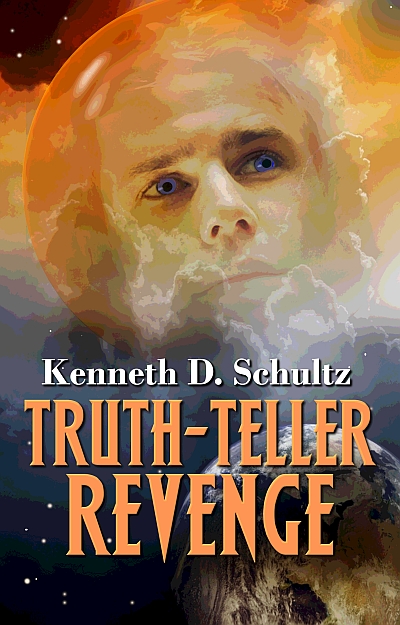
Truth-Teller Revenge Cover Art

TruthTellerRevenge-Ebook cover

I just received the cover art for Truth-Teller Revenge. It is fantastic! The artist is Trisha FitzGerald, who also did Truth-Teller Rebellion. Yes, Cary does get off the Earth in Revenge…although, getting back is a bit of a problem. I’m doing the final final edit of the galley right now. Revenge is on track for release in November.

Leave a comment

Filed under Art and Craft of Writing, Truth-Teller Books

Krin’s Struggle With Being an Empath

There’s a character blog hop going on! Audra Middleton recently wrote about Princess Willow in her novel Abomination. Then she tagged me. Check out Audra’s blog at http://www.audramiddleton.com/monthly-blog/meet-my-character-blog-hop.

1) What is the name of your character? Is he/she fictional or a historic person?

Krin is my favorite character in my Truth-Teller series. In Truth-Teller Rebellion, she is sixteen years old. She’s nineteen at the time of Truth-Teller Revenge, which comes out this November. She’s the younger sister of Cary Bishop, who is the protagonist of Truth-Teller Rebellion. Krin is the co-protagonist of Truth-Teller Revenge.

2) When and where is the story set?

The Truth-Teller books take place around the year 4000, but they aren’t your prototypical science fiction. Not too far in our future, the exhaustion of fossil fuels and global warming helped ignite devastating wars and a partial collapse of civilization. In time, global warming ran its course, but an ice age now grips the Earth. A shortage of energy leaves civilization stagnated, although medical technology has advanced far beyond current day technology.

Rebellion takes place in Washington and Oregon. Revenge takes place in the western half of North America, Hawaii, and in Space.

3) What should we know about Krin?

She’s plucky and not afraid to make decisions for herself. Some of her decisions are good, some could have been better, but she’s always doing what she thinks is right.

Krin is an empath and her personal story is how she deals with this ability. She can instinctively feel another’s emotions as if they were her own. Empaths are rare in her society, but her abilities go even further than those of most other empaths. She can project emotions into the minds of others. Realizing this last ability can be used for evil, she vows not to use it at all.

4) What is her main conflict? What messes up his/her life?

Krin sees her father and mother swept in a glacial lake outburst flood in Truth-Teller Rebellion. Afterwards, she’s unaware of the full extent of her and Cary’s unique abilities and she doesn’t understand the reason for multiple attempts upon their lives. She has to discover the truth about her past and her gifts in order to survive.

In Truth-Teller Revenge, like any woman, she’s looking for love and happiness. Instead, her father, the President of Columbia, is assassinated. She falls in love, only to find it’s forbidden. Her toughest decision is when she realizes Cary is intent on a suicide mission to defeat her father’s assassin. Can she help him without compromising her vow against manipulating the emotions of others?

5) What is her personal goal?

To find love, to remain true to her beliefs, and to keep what is left of her family alive.

Please check out Krin in Truth-Teller Revenge this coming November.

2 Comments

Filed under Truth-Teller Books