Category Archives: Book and Movie Reviews

The Personal Librarian – Marie Benedict & Victoria Christopher Murray

I found The Personal Librarian to be both enjoyable and educational, which in my opinion is what historical fiction should be. The book’s protagonist is a most remarkable woman, Belle da Costa Greene. Why was she remarkable? In 1905 at age twenty-six she became the personal librarian of J. P. Morgan for his new Pierpont Morgan Library. Morgan had at the time one of the world’s premier collections of rare books and illustrated manuscripts. Ms. Greene soon became much more than a librarian for Morgan, becoming his agent at auctions in the U.S. and overseas. Her drive, intelligence, determination, and Morgan’s money soon made the collection one of the best in the world. This was at the time when women were rare in the rare book world.

But, Belle da Costa Greene was even rarer. She was born Bell Marion Greener to a black father and mother. Her father, Richard Theodore Greener, was the first black student and graduate of Harvard in 1870. Upon her parents’ divorce, her mother chose to pass as a white of Portuguese heritage. Her fair complected sisters could do this easily. For the somewhat darker-skinned Belle this was more of a challenge.

Much of the book deals with the social and emotional costs of passing for white, including her relationship with black family members. The events of the book take place against the regression away from racial equality that occurred during this time period, a regression of which I was only vaguely aware.

Other interesting aspects of the book were the portrayal of J.P. Morgan, and the intricacies and duplicities of the artworld.

An ongoing theme of the book is Greene’s evident romance with art historian Bernard Berenson, who, ironically, was a Lithuanian Jew posing as a Catholic Bostonian. I gave the book four stars, instead of five, as it seemed it could have been more alive and visceral. By all accounts when you were in a room with Belle, you knew she was there. Reading about her, I didn’t get the same feeling. The third person approach used was a little too distant for me, and I think the story would have benefited by a first person narrative.

I visited the library many years ago, and didn’t then fully appreciate it. A return visit is now in order.
Leave a comment

Filed under Book and Movie Reviews

More Thoughts on The Invisible Life of Addie Larue

Upon publishing my review of The Invisible Life of Addie Larue, I checked out the other reviews on Goodreads. There are lots of good reviews, but I was surprised to see some readers had rated it extremely low. Fortunately, they also wrote lengthy essays justifying doing so. I understand that not all books are for all people, nonetheless I believe these reviewers are misguided in their opinions.

The issues brought up seem to center on the following:

               The book has no plot and is repetitive, at least until the end.

               Addie lived for over three hundred years through fascinating historical times, yet the narrative barely reflects these.

               There is only one person of color mentioned in the book.

Books generally have a plot and character development, but these characteristics will vary in their emphasis from book to book. For example, the James Bond books and DaVinci Code books have vigorous plots, yet James Bond and Langston are basically the same person at the end of the book as they were at the beginning. The Harry Potter and Game of Thrones books have both intricate plots and strong character development, at least for their younger protagonists. Books that predominantly focus character development over plot are somewhat rarer, but V.E. Schwab’s book is a prototypical example of one. It should be noted that this book does have a strong plot in regards to Addie’s relationship with the old god, which changes in interesting ways over the decades.

The book is somewhat repetitive, because Addie’s life was repetitive. Due to her condition of invisibility, she was consigned to a life on the fringe on society. How do you live without have meaningful, contractual relations with other people? She managed, but mostly through theft, artifice, and, to a degree, sex. The book explores how she managed to do so better over time, giving her a more meaningful, yet still stunted life.

Yes, this book could have delved into the historical eras through which Addie lived. It was the author’s choice to not do so other than in a passing way, and, in my opinion, she made the correct choice. Delving into historical subplots would have been a distraction from the prime focus of the story: how does one survive if you are effectively invisible. Also, being that Addie operated on the fringe of society, she wasn’t generally well positioned to observe many historical events. Lastly, as to their only being one person of color, for most of Addie’s life she lived in places without many people of color. I don’t believe a book should be penalized for this. I will soon review a book, The Personal Librarian, that deals extensively and predominately with issues of people of color. There is room enough for both books to happily coexist in this world.

Leave a comment

Filed under Book and Movie Reviews

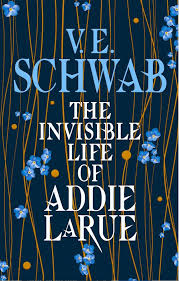
An Enchanting Read: The Invisible Life of Addie Larue by V.E. Schwab

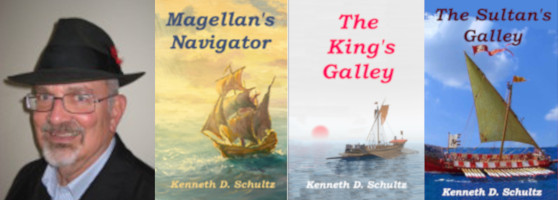
I’ve been reading more books lately, including the excellent The Invisible Life of Addie Larue, but I’ve also been writing less since the completion of Drake’s Botanist. One reason was for this is that with Covid becoming less virulent, my wife and I are willing to travel. Our first big trip, as posted in this blog last year, was to Spain and Portugal. This was a special treat as I was able to visit locales of scenes in Magellan’s Navigator and a not-yet-published sequel to Drake’s Botanist. More recently we sailed from Sydney, Australia to Seattle, Washington, via New Zealand (I love the place), Tahiti (a tropic beauty), and Honolulu (I climbed Diamond Head!). Next up is a planned cruise in the Mediterranean where we will visit many locales of The King’s Galley and The Sultan’s Galley.

The Invisible Life of Addie Larue is a favorite of my more recent reads. Its premise has an original aspect, the protagonist Addie Larue is sympathetic, there are intriguing twists to the story, and the prose is excellent. The basic premise of this magical realism book is an old one. Addie Larue sells her soul to the Devil, or a devil, or an old god, or maybe simply a magical being. It never is clear. From this initial start, the story is all original.

Addie is a uniquely independent French girl, born 1691 in the provincial town of Villon-sur-Sarthe. She yearns for more than a life of bearing children and married subservience. She eludes that fate for some years, until it is decided she must be wed. On the wedding day she runs. About to be caught she meets a man, or an old god. She pleads with him, “I want a chance to live. I want to be free…I want more time.” He asks “How long?” She doesn’t know. He becomes frustrated, and explains that he deals in souls. He will wait for her soul, but not forever. She tells him, “…take my life when I am done with it. You can have my soul when I don’t want it anymore.” This is a deal the old god will do. Addie accepts, not realizing the old god has rigged the game in his favor. No one will ever remember Addie. She can knock on a door and have a conversation, but when the door closes and reopens, the person has no recollection of her. Even her mother and father don’t remember her being their daughter.

This would make life impossible for most people, but Addie persists and finds a way to manage over the years without going insane. She seems to be immortal. I found it fascinating how she forges a life for herself. Periodically the old god visits her, hoping to take her soul. Their changing relationship over the centuries is an interesting subplot of the book. Finally, in New York in the present, she meets a man who remembers her. That leads to the climax of the book, although not necessarily the end of Addie’s story. Or maybe it is the end of her story. I don’t want to spoil the finale for you. Once I always finished a book once I started it. Now, I finish a minority of the books I start. I am a tough grader of books, but on a scale of one to five, I give this book a six.

Leave a comment

Filed under Book and Movie Reviews

Genius, a movie about Maxwell Perkins and Wolfe

Genius, a movie about the great editor Maxwell Perkins (think Fitzgerald, Hemingway and more) and Thomas Wolfe is coming out. That will be a must see for me. If such things interest you, the following link will be of interest.

http://www.publishersweekly.com/pw/by-topic/authors/interviews/article/70466-four-questions-for-max-perkins-biographer-a-scott-berg.html?utm_source=Publishers+Weekly&utm_campaign=2edddcb834-UA-15906914-1&utm_medium=email&utm_term=0_0bb2959cbb-2edddcb834-304609113

Leave a comment

Filed under Art and Craft of Writing, Book and Movie Reviews, Uncategorized

The Serious Side of Whiskey Tango Foxtrot and Arturo Perez-Reverte’s The Painter of Battles

Tina Fey is my favorite comedic actress of this era, and she does a superb job in Whiskey Tango Foxtrot. There is, however, a serious side to virtually every laugh in the movie. The unintended results of the press are an important part of the film. Like the uncertainty principle, where the act of observing affects ‘reality,’ the act of reporting, especially reporting war, can affect the lives of all involved. I can’t say more without giving out spoilers.

These issues are at the heart of Spanish author Arturo Perez-Reverte’s The Painter of Battles. I’m a huge fan of Perez-Reverte. He’s mostly an author of historical fiction including his Captain Alatriste series and The Fencing Master. His contemporary The Dumas Club was made into a The Ninth Gate starring Johnny Depp. These are all fast paced, tightly plotted books.

Perez-Reverte was a war correspondent, like the Tina Fey character in Whiskey Tango Foxtrot, before becoming an author. The Painter of Battles appears to be his attempt to deal with the atrocities and cruelty of man against man he encountered in his journalistic career. It is a very philosophical novel, and quite different from his other works.

The protagonist, the painter of battles, was a war photojournalist for over thirty years. He has abandoned this profession and, when we first meet him, is painting a mural of battles in a tower on the Spanish coast. One day a former Croatian soldier arrives at the tower, and announces that he is going to kill the painter of battles, although first the visitor wants to talk. A series of philosophical discussions then ensues about war, journalism, mankind, and what drove these two men to this destiny. It would seem Perez-Reverte is processing specters haunting him from his years as a war correspondent.

The Painter of Battles was at times too verbose for me, and it wasn’t my most enjoyable read of the past year. However, I’ve certainly thought more about this book after finishing it than any other I’ve recently read.

2 Comments

Filed under Book and Movie Reviews, Uncategorized

Across a Billion Years by Sci Fi legend Robert Silverberg

Across a Billion Years is a first contact novel written by sci fi legend Robert Silverberg back in 1969. It’s interesting how some sci fi holds up well over the years, while other sci fi falls apart. Dune, for example, reads as well to me today as when I first turned a page in it forty plus years ago. It’s setting in a rather fantastical future helps. Sci fi that is more predictive, like Across a Billion Years, can more easily become book wormed with age. Fortunately, Across a Billion Years generally escapes this fate.

The year is 2375. Mankind has fast interstellar propulsion and interstellar communication via telepathy. (Space Sci fi requires both in some form or the author is severely limited.) The protagonist Tom Rice is a newly minted college graduate on an archaeological expedition to dig for artifacts on Highby V relating to The High Ones, who left their mark across the galaxy a billion years earlier.

The discovery of artifacts propels the plot as they attempt to discover the fate of The High Ones’ civilization. A subplot is the internal strains within the team brought on by racial tension between its five humans, five other alien races, and one human android. Another subplot concerns Rice’s romantic interests. Rice is initially quite naïve, and, although he doesn’t realize it, pretty opinionated and bigoted. He shows quite a bit of character development over the course of the novel.

The novel is presented as Rice’s communication to his sister as stored in a memory cube. That wouldn’t be my preference, but it works reasonably well.

The plot and subplots worked for me as did Rice’s character development. However, the book is more contemplative than action-packed. I thought the book floundered some at the end, and found the ending not satisfying. The secondary characters were rather lightly drawn, and more caricatures, than characters. I was particularly disappointed that the androids persona was explored more. Some of the science that was cutting edge in 1969, and that Silverberg spends many words on, is obsolete today, and not of interest to the modern reader.

Overall, the book was a quick read for me at 232 pages and maintained my interest. I rate it four stars considering its vintage. If it were modern, I’d knock it down a star. Personally, I think its regular Kindle price of $7.99 is too high, but I purchased it on sale via BookBub.

Leave a comment

Filed under Art and Craft of Writing, Book and Movie Reviews, Uncategorized

A Summer of Reading and Writing

It’s been a productive summer for me of reading and writing. On the writing side, I’m nearing completion of the first quality draft of my sci fi book Mindfield after figuring out the final chapters while on vacation. The final proofing of my historical fiction Magellan’s Navigator is in process. Thanks to Laura Henson, Dave Mueller, and Kerry Stevens for their invaluable beta read of this manuscript. I’ll need covers for both these books and formatting both for ebook and paperback. Being an indie author isn’t easy. Equally exciting, I’m part of a newly formed group of serious writers meeting regularly for critiques.

I’ve done a lot of reading this summer, due in part to my discovery of the great deals on Bookbub. (I’ve had to restrain myself lately, as it’s easy to build up a backlog of books.) My favorite author of my summer reads is Lindsay Buroker. While on vacation, I finished her “boxed set” Forgotten Ages. This steampunk set consists of her Encrypted, Enigma, and Decrypted novels. These books have good characters, fast moving plots, and an intriguing world. Most of all, I liked her voice and her use of language. It’s much more alive than that of many authors. And, from her facebook page, it looks like she’s a fellow Vizsla owner!

Whether you’re a fantasy reader or a writer of any genre, I suggest you check out Ms. Buroker’s webpage at www.lindsayburoker.com.  She’s proof that a hardworking writer can make it as an indie writer, and her blog has lots of useful info on the secrets to her success.

Leave a comment

Filed under Art and Craft of Writing, Book and Movie Reviews, Magellan's Navigator, Mindfield

Secondhand Lions: Caine, Duvall, and Haley Joel Osment

Secondhand Lions has great actors, a twisty story line, and a lion. What more can a person ask for? My wife and I watched this 2003 movie at the suggestion of a friend and thoroughly enjoyed it. Osment is dumped off by his mother with two old great uncles, who may be rich. At least the Mother and other relatives think so. Initially the uncles all but ignore poor Haley, who has bounced around relatives and orphanages all his life. When he runs away, first the uncle played by Caine, and then the enigmatic uncle played by Duvall, accept the responsibility to raise him. The Duvall uncle has a past that haunts him in his sleepwalking nights. But was he really in the French Foreign Legion, or was he a bank robber, or is all of it bunk? The main three actors give fantastic performances as Haley’s character goes from a castoff young fourteen-year-old to a confident young man.

Writers should watch the director’s commentary where he talks about the balance between exposition and pacing, and character transformations.

Leave a comment

Filed under Art and Craft of Writing, Book and Movie Reviews

Stormlight Archive: What I Like About It and What I Want To Emulate


I recently finished Brandon Sanderson’s The Way of Kings and Words of Radiance, the first two books in his planned Stormlight Archive series. Both are thousand plus page books.

The books are an excellent, multi-faceted fantasy with engaging characters and an imaginative world. This isn’t a retread of orcs and elves, but an entirely original world. Most the story revolves around an enslaved warrior, a middle-aged battle-weary prince, and an ambitious young female scholar. In the first book, magic doesn’t seem common in the world, although mysteries abound in the world. In a masterful way, Sanderson slowly reveals the world’s truths to the characters and the reader, although beware, everything revealed may not be indeed be the truth. He does a great job. I found myself identifying with all three major protagonists.

Things I liked are the story’s originality, empathetic characters, and the twists and turns of character reveals. This story is huge and multi-layered. I haven’t figured out how everything fits together, but I will trust the author that it does. I like the way most, if not all, the baddies aren’t out and out evil like the Dark Lord of Mordor. The villains are generally doing what they think is right, although that may not be apparent at the first.

Things that could be improved: there was surprising number typos in the first book. Some people complain about typos in self-published works. Well this book is the product of a major publisher. The second book has far less typos. These books are not page-turners. Sanderson slowly develops things, and as a reader, I relaxed and enjoyed that. That said, enough is enough at times, and one or two hundred pages could be sliced out each book without hurting the story (you can skim without hurting the reading experience.) Occasional scenes don’t seem to ring true, but hey, there are many scenes and another person might have a different opinion.

One takeaway for me as a writer is that I especially liked Sanderson’s slow reveal of his world and characters’ backstories. I’ve always regretted revealing the circumstances of Adam’s sister’s death as early as I did in Download. Originally, it was much later in the novel, but I moved it up after a beta reader said he wanted to know it NOW. Well, maybe he did want to know it now, but that didn’t mean I should have given it to him now.

On the other hand, I did find annoying Sanderson using entire chapters of “five years earlier.” I cringed when I saw that in a chapter heading, and prefer having the backstory weaved into the here and now story.


Leave a comment

Filed under Art and Craft of Writing, Book and Movie Reviews

The Imitation Game – Superb Movie But Questionable History – Which is Good!

My wife and I saw The Imitation Game yesterday. It’s a fantastic movie. Benedict Cumberbatch’s performance deserves an Oscar. Cumberbatch portrays the great mathematician Alan Turing, who has a cameo role in my thriller Download. The movie is about Turing’s tortured personality, but it is centered about the breaking of the unbreakable Nazi Enigma code in World War II. I’ve been interested in codebreaking since my Navy time at the Naval Security Group, and codebreaking and electronic intercepts are a key component of Download.

The Imitation Game revolves around real historical people and real historical events. By all accounts the movie does not deal faithfully with either. Turing played a critical role in the breaking of the Nazi Enigma code, but he was one person of a huge effort involving thousands of people, not the six analysts in the film. Turing’s film personality is also likely not accurate.

These inaccuracies are good. A painstakingly faithful history of the codebreaking effort would be boring. The Imitation Game captures the essence of this effort, the social restrictions of England seventy-five years ago, and the moral dilemmas faced by Turing, Winston Churchill, and all in the intelligence community when they finally held the uncoded Enigma messages. Do they use the information now and save lives, but risk compromising their codebreaking efforts, or do they use the information more judiciously and strategically?

In less than two hours the makers of The Imitation Game successfuly capture the essence of these times and people better than a history book. I encourage you to see the movie if you haven’t already.

Leave a comment

Filed under Art and Craft of Writing, Book and Movie Reviews, Download