Category Archives: Art and Craft of Writing

Odds and Ends

I planned on reviewing the 1989 Hugo Award winning novel, Hyperion, this week, but…when I got to the end of the Dan Simmons novel I discovered…it wasn’t the end! And I had to know what happened. So I’m nearing the end of The Fall of Hyperion. These two books are really one thousand page plus novel.

I love Hyperion and will soon publish a full review of it. I did find myself skimming over some of the descriptions in it, which made me reconsider my own writing. Champagne’s editor of November’s Truth-Teller Revenge  said she found herself skimming through some of my descriptive passages. Hmm. It can be a fine line between giving your reader a vivid image of the setting, and boring the reader or slowing down the story. So I find myself cut, cut, cutting, as I rework my works-in-progress.

I expect to see the cover art for Truth-Teller Revenge any day now, which I’ll share. I should also soon have the galleys to proof, which will mean a week of intensive work.

Meanwhile, I’m enjoying the final days of this wonderful, sunny summer. Tomorrow I’m off to Paul Allen’s Flying Heritage Collection to see their B-25 and Hellcat fly at noon!

Leave a comment

Filed under Art and Craft of Writing, Book and Movie Reviews, Truth-Teller Books

Xenophobia, a unique first contact novel

Xenophobia is a good first contact novel, but could be better. I quickly became invested in the main character, a Dr. Bowers, and the U.S. Rangers that guard her. They’re in the midst of an African civil war when first contact occurs. Surrounding them are warlords with too little brains and too many drugs and guns. Can Bower and the Rangers get to safety?

The plot was good, the aliens were unique, and I cared about the characters. The Rangers were not just cookie cutter soldiers.

I give the book three and a half stars. It has two flaws. First, there are occasional long preachy soliloquies that slow down the book if you read them and are unnecessary if you don’t read them. They are a clear case of author intrusion. The other flaw is that the reader learns of most the human/alien interaction by Bower and the Rangers listening to the radio. Yeah, it’s all fiction, but I could believe what was happening to Bower was real. The reports on the radio just seemed like made up stuff. I think the author should have had another protagonist, perhaps a brother of Bower, who directly experiences the human/alien confrontations, rather than have a periodic telling of the first contact.

Leave a comment

Filed under Art and Craft of Writing, Book and Movie Reviews

Got the Second Round Done!

The second round of edits of Truth-Teller Revenge were due today to my outstanding editor. I sent them off at ten last night. This book will be fantastic. Krin has an even bigger role than in Truth-Teller Rebellion. I can’t wait until September to see Revenge’s cover.

Leave a comment

Filed under Art and Craft of Writing, Truth-Teller Books

HOW MANY STARS? USEFUL AND USELESS BOOK REVIEWS.

Authors lust over getting good reader book reviews on Amazon. Good reviews help drive sales, plus it also feels good. Therefore, as a courtesy, I make an effort to review each book I read. I take this responsibility very seriously. I put a chunk of time and thought into my reviews. The hardest part, for novels, is the star rating I assign.

Fiction is subjective. I don’t have a problem giving a non-fiction book a low rating. Hey, if it has errors in fact or logic, it deserves a low rating. Fiction isn’t nearly as easy.

I typically look at a few five star, three star, and one star reviews before buying a book. Too often, I see a review that says, “I received this book free in return for an honest review. Now I don’t normally read (fill in the genre, it could be romance, sci fi, fantasy, or …).” Then why did you accept the book? Invariably the book’s given a three star rating. I mentally toss out that review. A bad or mediocre review isn’t useful unless it’s for a genre the reader enjoys.
Similarly, there are different writing styles. I don’t think my rating should reflect my like or dislike for a writing style. I started Samuel R. Delaney’s Dhalgren. I didn’t finish the first page. Many people like the book. The book has sold over a million copies and was nominated for a Nebula award. Personally, I didn’t care for its muddled stream-of-insane-consciousness writing style. Some readers have thought the same. Should I give Dhalgren a one star rating? I did hate it, but that was a reflection on my dislike for the style. I’d be rating a writing style, not the book itself, if I gave the book one star. I chose instead to simply not rate Dhalgren.

So my fiction reviews tend to be four or five stars with an occasion three stars. I focus on how imaginative the plot is, how engaging the characters are, and overall how well the book entertained me.

What are your thoughts on rating and reviewing books?

Leave a comment

Filed under Art and Craft of Writing, Book and Movie Reviews

I’m Interviewed on Audra Middleton’s Blog

Audra Middleton interviewed me on her sci fi madness blog series today. I talk about what makes a good sci fi novel, researching Truth-Teller Rebellion, and writer’s block. Check it out at http://www.audramiddleton.com/1/post/2014/05/interview-with-kenneth-schultz.html.

Leave a comment

Filed under Art and Craft of Writing, Science of the Truth-Teller World, Truth-Teller Books

BLOG HOP: My Writing Process

Image

Today’s blog is my contribution to an ongoing blog hop. Last Monday Ute Carbone wrote about her writing process at http://ute-carbone.blogspot.com and passed the blog hop torch to me. 

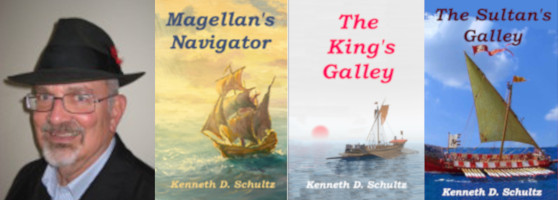
Why do I write and what am I working on? I write because I enjoy creating and telling stories. My books go through several phases: idea, outline, first draft, finished draft, and then edit, edit, and edit. I’m doing the first draft of the third book in my Truth-Teller series. My meticulous wife is doing the final proofreading of Goldbach’s Conjecture. I wrote this thriller about a National Security Agency geek and high-frequency trading four years ago. I’m also in the outline phase of Magellan’s Pilot, which is a complete rewrite of my first (unpublished) novel. Usually I work on one project at a time, but I want to clear out some old manuscripts. 

How does my work differ from others in its genre? I strive to be different through setting, characterization, and writing style. The worlds of most sci fi novels have limitless energy. Cary and Krin in Truth-Teller Rebellion have only solar, wind, and hydro energy, while an ice age grips their world. As to writing style, many have commented on my vivid descriptions. 

How does my writing process work? A work starts with an idea. I come up with these all the time. Some percolate in my mind for years. Before they graduate from idea to book, I must love the idea, be willing to spend six months writing the book, and even more months editing it. I also ask if the book is marketable and does it fit with my existing works. Ultimately, my passion for the book is the deciding factor. 

Upon deciding I will pursue a premise, one of my first decisions is whether to write the book in first or third person and from whose point-of-view(s). Then I do a rough chapter-by-chapter outline. Outlining is essential for me. It’s when I work out all the kinks in the plot, which helps me avoid excessive rewriting. Without an outline, I’ve seen writers back themselves into a literary corner, and have to use unrealistic shenanigans to get their novel moving forward. 

Once the outline is set, I write. The actual act of writing I liken to doing a painting. A painter doesn’t start in one corner of the canvas and expand from there. Similarly, I don’t attempt to do write an entire scene with exposition and dialog at once. First, I write down the main events of the scene and any reveals I want to make. Then I write dialog along with a few key actions. Dialog is the backbone of my books. Readers rarely skip dialog, although they may skip exposition. I know I skip over the menus in the Game of Thrones series. Conflict between characters is the key to a story, and dialog unlocks that conflict. 

I don’t typically write scenes sequentially. When writing I place myself in the head of the point-of-view character in each scene. For me skipping from one character’s head to another is too schizophrenic. For example, in the TTR series Cary is my main protagonist, although his sister Krin also has a major role. For continuity, I’ll write a series of Cary scenes and then write a series of Krin scenes even though these scenes or chapters are interspersed in the final product. 

I’m goal oriented, so I keep a log of words written. I shoot for a thousand a day, but actually average around five hundred while writing a first draft. I want to get the first draft finished while everything is fresh in my head. Once the first draft is finished, I edit, edit, edit. My objective is to finish the novel. It’s easy to start a novel, but a lot of work to finish one. 

The writing process blog hop jumps to Audra Middleton next Friday, April 25th. I’m looking forward to learning about her writing process at http://www.audramiddleton.com. Audra Middleton is the mother of three boys and the author of three books: WatcherHitchhiker, and Abomination. Her Facebook page is http://www.facebook.com/AudraMiddletonAuthor. I recently read Audra’s Hitchhiker and thoroughly enjoyed it. I’ll be posting a review of it later this week.
Leave a comment

Filed under Art and Craft of Writing